FABIAN-variant 2026 is a major update to the web application for predicting variant effects on transcription factor binding. This page summarizes the key changes compared to the original version. See the changelog for a complete history of updates since the initial release.
Expanded model library
FABIAN-variant 2026 integrates 40,315 prediction models for human and 35,990 models for mouse (the original version included approximately 5,000 models for human only):
- 1,290 TFFMs (transcription factor flexible models) from JASPAR 2024
- PWMs from nine databases:
- JASPAR 2026 (3,357)
- HOCOMOCO v14 (6,307)
- CIS-BP 3.00 (6,473)
- SwissRegulon (1,316)
- Factorbook (15,061)
- SELEX collection (4,635)
- UniPROBE (1,403)
- HOMER (333)
- hPDI (140)
The number of supported human transcription factors increased from 1,387 to 1,530, with an additional 1,420 heterodimer complexes (e.g., AHR::ARNT, BACH1::MAFK). For mouse, 1,123 transcription factors and 1,355 heterodimer complexes are supported.
Deep learning predictions
In addition to PWM and TFFM scoring, FABIAN-variant 2026 offers deep learning predictions using 1,259 BPNet models from the JASPAR 2026 collection, covering 240 human TFs. BPNet is a convolutional neural network trained on human ChIP-seq data that predicts base-resolution TF binding profiles.
For each variant, two metrics are computed: the log2 fold change in predicted read counts and the Jensen–Shannon distance between the reference and variant binding profiles. Both single nucleotide variants and indels are supported.
Mouse genome support
In addition to human (GRCh37/hg19, GRCh38/hg38), FABIAN-variant 2026 supports the mouse genome:
- GRCm38 (mm10)
- GRCm39 (mm39)
VCF files can be filtered by strain frequency using Mouse Genomes Project (MGP) data.
Known TFBS databases
Known transcription factor binding site (TFBS) data now draws on five sources: ENCODE, ReMap 2022, ChIP-Atlas, UniBind, and Ensembl Regulation (replacing the three used previously: ENCODE, Ensembl Regulation, and FANTOM5). ENCODE, ReMap, and ChIP-Atlas provide experimentally determined TF binding regions from ChIP-seq data. UniBind identifies direct binding sites within ChIP-seq peaks, and Ensembl Regulation provides computationally predicted motif features within candidate regulatory regions.
On the search page, users can select which TFBS databases to include when filtering by known binding sites. On the results page, hovering over a known TFBS indicator shows which databases confirmed binding at the variant location, and a database filter allows restriction to a specific source.
Heterodimer TF complexes
FABIAN-variant 2026 includes prediction models for 1,420 heterodimer TF complexes in human and 1,355 in mouse (e.g., AHR::ARNT, BACH1::MAFK), representing cooperative binding by TF pairs. Three display modes are available on the results page:
- Exclude (default): heterodimers are hidden entirely
- Merge: heterodimer predictions are merged with their component TFs
- Show separately: heterodimers appear as independent entries
RESTful JSON API
A new asynchronous RESTful API provides structured JSON responses for integration into automated pipelines. See the API documentation for details.
Standalone version
A standalone version is available for local execution, enabling high-throughput workflows and analysis of sensitive data on local infrastructure. See the standalone documentation for details.
Technical infrastructure
FABIAN-variant 2026 is hosted at https://fabianapp.org/variant26/. The web application infrastructure has been completely rewritten:
- The legacy Perl/CGI backend has been replaced with a dedicated Rust HTTP server. Unlike CGI, which spawns a new process for each request, the Rust server runs persistently and handles requests asynchronously.
- The previous version relied on the Slurm workload manager, introducing queue latency. The new implementation uses custom internal job scheduling, resulting in faster job startup.
- Status monitoring has moved from AJAX polling to WebSocket connections. Progress updates are now pushed to the browser as they occur.
As a result of these changes, end-to-end runtime is reduced by approximately 70%: 69% for single-variant searches, 72% for 100-variant batches, and 76% for 10,000-variant VCF files.
Unified model logo style
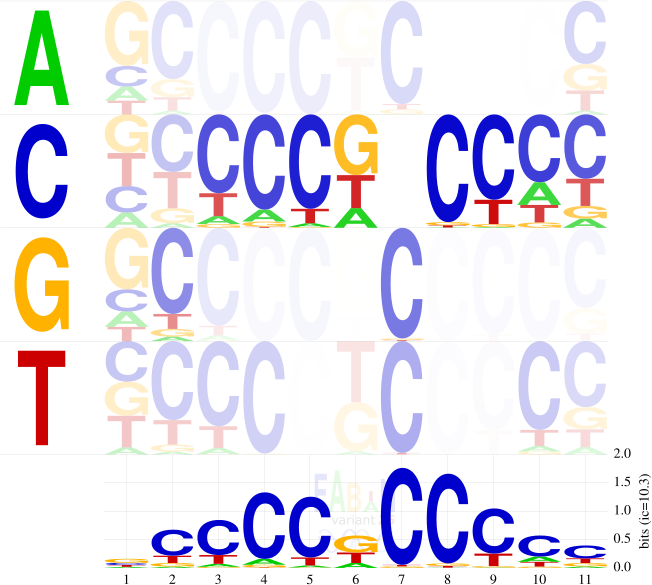
All TFFM model logos have been custom-generated using LaTeX, matching the visual style and colours of PWM logos.

Usability improvements
User interface improvements include:
- Automatic genome build detection from VCF file names
- Quick links for selecting all or none of the filter options
- Simplified population frequency filtering using gnomAD only
- Gene name autocomplete when filtering VCF variants by gene regions
- Thousands separators in all count displays
- Same-species model filtering on the results page (restrict results to models from the same species as the query genome)
- Score filters on the results page to show only transcription factors or variants whose combined binding score reaches a chosen minimum (default 0.05), with a separate cutoff to hide individual low-scoring models
- On the detailed results page, a dot (•) next to a model's score indicates that it contributes to the combined score
- Result table cells are links, so a middle-click or Ctrl-click opens the detailed view in a new browser tab
- Sequence logos displayed when hovering over the table on the detailed results page
- Section links on the detailed results page
- Option to save projects via email verification, extending the retention period beyond the default 14 days