Contents
About
FABIAN-variant predicts the effect of DNA variants on transcription factor (TF) binding in human (Homo sapiens) and mouse (Mus musculus) genomes. Given a non-coding or regulatory variant, FABIAN-variant evaluates whether the variant is likely to disrupt, create, or alter transcription factor binding sites (TFBS). The analysis uses 40,315 models for 1,530 human TFs and 35,990 models for 1,123 mouse TFs, plus 1,259 optional deep learning models. Results are reported as a score between −1 (predicted binding loss) and +1 (predicted binding gain).
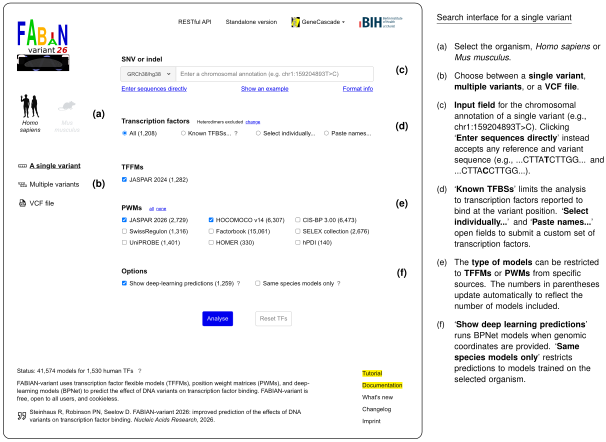
To get started, visit https://fabianapp.org/variant26/ and enter the DNA variant into the SNV or indel field, select one or more transcription factors and click on Analyse. If you do not know the location but have a reference and a variant sequence, you can still enter them by clicking on Enter sequences directly.
Interfaces
Search interface
Results page
Detailed results page
Click on an image to enlarge it.
Variant input
FABIAN-variant supports five input modes for variants. In each mode the supported formats can be displayed by clicking on the link 'Format info' below the input field.
- Single variant: Chromosome, genomic position, reference base(s) and variant base(s) have to be entered in one of the following formats:
1:159204893T>C(default)1:159.204.893T>C(dot as thousands separator)chr1:g.159,204,893T>C(comma as thousands separator)1-159204893-T-C(gnomAD)1 159204893 . T C(VCF)1 159204893 T C(VCF without ID column)
- Single variant (sequences): The reference sequence and variant sequence may consist of letters ACGT.
Sequences of about 30 bases are recommended.
For example:
- Reference sequence:
AGTCCTTGGCTCTTATCTTGGAAGCACAGGC - Variant sequence:
AGTCCTTGGCTCTTACCTTGGAAGCACAGGC
- Reference sequence:
- Multiple variants: The accepted formats are the same as for a single variant (see above).
One variant has to be entered per line (separated by newline character).
Up to 100 variants can be submitted in batch mode.
For larger inputs, use the VCF file mode.
The genome build selection must match the chromosomal annotation in your variants.
For example:
chr1:159204893T>C

              chr11:61828092C>T
- Multiple variants (sequences): The only accepted format is a space-separated list of reference and variant sequences with one variant per line (separated by newline character).
Up to 100 variants can be submitted.
For example:
AGTCCTTGGCTCTTATCTTGGAAGCACAGGC AGTCCTTGGCTCTTACCTTGGAAGCACAGGC

                TCGAGGCCCTGAGCTCCCGGGGAGTTTTTAC TCGAGGCCCTGAGCTTCCGGGGAGTTTTTAC
<Ref> <Alt>where each <Ref> sequence and <Alt> sequence may consist of letters ACGT. A space character is used to separate <Ref> and <Alt> and a newline character to separate two variants. Sequences of about 30 bases are recommended.
<Ref> <Alt>
<Ref> <Alt>
...
- VCF file:
Input files have to be in VCF format.
The uploaded VCF file may only contain data from one sample (support for multi-sample VCF files is limited).
Please zip or gzip large VCF files before upload.
A maximum of 10,000 variants is processed per file.
- The contents of a small sample VCF file (TinyExample38.vcf) are printed below:
2 127418425 . T C 116 PASS . GT:DP 0/1:154 10 6051177 . G A 116 PASS . GT:DP 0/1:154 X 80014682 . G A 116 PASS . GT:DP 0/1:154 - A sample whole-genome sequencing VCF file can be found in the tutorial.
- Positions with very low coverage do not provide reliable data, and excluding such positions is recommended for VCFs called from raw sequencing reads.
FABIAN-variant can skip variants whose
DPvalue falls below a user-defined threshold. To use this, enable the 'Minimum coverage' filter in the VCF options and set a minimum read depth (the field is pre-filled with 10). The filter is disabled by default, so all variants are analysed regardless of coverage and VCFs withoutDPvalues are unaffected. - The GT values determine which alternative alleles in each VCF line are analysed:
1for the first alternative allele and2for the second alternative allele (see VCF documentation for details). Diploid and haploid calls are supported. Alternatively, if you do not specify GT, all alternative alleles will be analysed. - For multi-sample VCF files, only the first sample is considered. For example, if the GT value of the first sample for a particular variant is 0/0, this variant will be classified as 'is_refseq' and skipped. Skipped variants are not analysed and are included in a file called 'skipped.txt' that can be downloaded from the results page. By selecting the option 'Ignore GT and analyse all ALT alleles', you can bypass the GT checks and allow analysis of all variants in a multi-sample VCF file.
- Population filters (human): Variants can be filtered based on their frequency in gnomAD. This filter is disabled by default. When enabled, variants can be excluded based on the number of homozygous individuals (default threshold: 10) or total carriers.
- Strain filters (mouse): Variants can be filtered based on their presence across Mouse Genomes Project (MGP) inbred strains. This filter is disabled by default. When enabled, variants present in the specified number of strains or more are excluded.
- The contents of a small sample VCF file (TinyExample38.vcf) are printed below:
Transcription factors
FABIAN-variant 2026 integrates 40,315 prediction models for 1,530 human transcription factors plus 1,420 heterodimer complexes (e.g., AHR::ARNT, BACH1::MAFK). For mouse, 35,990 models for 1,123 transcription factors and 1,355 heterodimer complexes are supported.
The models were pooled from nine publicly accessible PWM databases together with TFFMs from JASPAR 2024. Models are assigned to each organism by matching TF gene symbols against reference lists from HOCOMOCO and CIS-BP. Models matching both species are included in both sets. Per-source model counts for each organism are shown below.
| Source | Type | Models for human TFs | Models for mouse TFs |
|---|---|---|---|
| JASPAR 2026 | PWM | 3,357 | 2,903 |
| HOCOMOCO v14 | PWM | 6,307 | 5,044 |
| CIS-BP 3.00 | PWM | 6,473 | 5,580 |
| SwissRegulon | PWM | 1,316 | 1,313 |
| Factorbook | PWM | 15,061 | 13,682 |
| SELEX collection | PWM | 4,635 | 4,414 |
| UniPROBE | PWM | 1,403 | 1,403 |
| HOMER | PWM | 333 | 318 |
| hPDI | PWM | 140 | 117 |
| JASPAR 2024 | TFFM | 1,290 | 1,216 |
| Total | 40,315 | 35,990 |
TF names from different databases are mapped to their canonical gene symbol (HGNC for human, MGI for mouse). For example, models listed under the protein name P53 in HOCOMOCO are displayed under the gene symbol TP53.
The TF selection list has three heterodimer modes, cycled by clicking the button below the list: Heterodimers excluded (default) hides all heterodimer entries; Heterodimers merged into TFs joins heterodimers into their component TFs, so that selecting ARNT automatically includes models for heterodimers containing ARNT, such as AHR::ARNT; Heterodimers shown separately displays heterodimers as individual entries that can be selected independently.
1,290 transcription factor flexible models (TFFMs) from JASPAR 2024 are included. For each transcription factor, FABIAN-variant combines the results of multiple models into a final prediction of the binding affinity change.
In addition, 1,259 deep learning models (BPNet) covering 240 human TFs from the JASPAR 2026 Deep Learning collection predict binding changes from the sequence context around the variant, available when genomic coordinates are provided. See Deep learning models (BPNet) for details.
The data sources are covered by different licenses, listed in the Acknowledgements.
Known transcription factor binding sites
On the results page, FABIAN-variant highlights known binding sites for transcription factors with a black rectangle around the score. The number of transcription factors that each source covers, per assembly, is shown below (a dash means the source does not cover that assembly):
| Source | hg19 | hg38 | mm10 | mm39 |
|---|---|---|---|---|
| ENCODE | 491 | 922 | 39 | - |
| ReMap | 875 | 875 | 414 | 414 |
| ChIP-Atlas | 1,071 | 1,071 | 469 | - |
| UniBind | - | 267 | 268 | - |
| Ensembl Regulation | 42 | 42 | - | 1 |
| Distinct TFs (union) | 1,161 | 1,205 | 515 | 414 |
On the search page, the databases used for the 'Known TFBSs' TF filter can be selected individually (ENCODE is selected by default). On the results page, hovering over a cell with a known TFBS shows which databases confirmed the binding site.
Please note that this function is only available if you entered genomic positions. Because the binding regions provided by ENCODE, ReMap and ChIP-Atlas are several hundred bases long, a highlighted position does not necessarily contain a binding site for the TF at the exact variant location. UniBind and Ensembl Regulation instead provide motif-level sites (about 15 bases), which are localised more precisely.
Evaluation of TFFMs and PWMs
TFFMs and PWMs are evaluated at every position overlapping at least one variant base, on both strands, in both the reference sequence and the variant sequence. The highest score in the variant sequence is compared with the highest score in the reference sequence. A higher Ref score than Alt score indicates weakened binding (a loss), and a higher Alt score indicates strengthened binding (a gain). For each model, FABIAN-variant generates a per-model score S between −1 (likely binding loss) and +1 (likely binding gain) as: S = tanh(F · ln 2), F = salt − sref 1 − max(sref, salt) + α
with pseudocount α = 0.1 to avoid zero in the denominator. The figure below illustrates S for all combinations of reference and alternate scores in [0, 1]. Blue indicates a predicted binding gain, red a predicted loss. Hover over the plot to read exact values.
Per-model scores with |S| < 0.001 are labelled NA.
To obtain the combined score from multiple models, FABIAN-variant averages the per-model scores S. If both TFFMs and PWMs are available, by default only the results from TFFMs are used for the combined score (this setting can be changed by unchecking 'Options > Prefer TFFMs' on the results page).
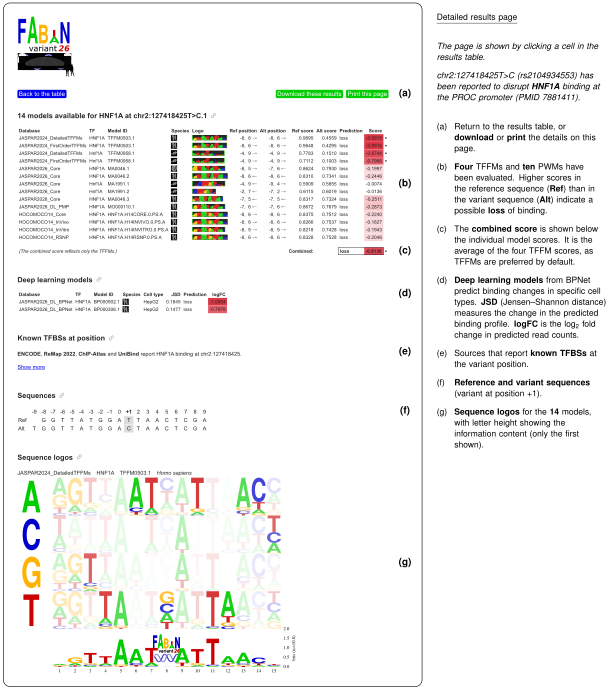
The Ref score, Alt score, the per-model score S and the combined score are shown on the results page. For example:

In the detailed results table, a dot (•) next to each model indicates whether it contributes to the combined score. Models without a dot are excluded because 'Prefer TFFMs' is enabled (default) and TFFMs are available for this transcription factor.
The Ref and Alt position columns show the location of the highest-scoring motif match relative to the variant site, formatted as start,end with an arrow indicating the DNA strand (→ plus, ← minus).
The species column shows the organism(s) from which the model was derived. This is separate from the organism selected for the analysis (human/mouse), so a human analysis also reports models derived from mouse data. With the 'Same species models only' option on the search page or the 'Same species only' results filter, the analysis can be restricted to models derived from the same species as the selected genome. This may leave some transcription factors with no models from a given source, or with no models at all.
Score magnitude reflects the predicted strength of the binding change. Large positive or negative combined scores more reliably indicate a gain or loss of binding, whereas scores close to 0.0 are less certain and should be interpreted with caution. In a benchmark against experimental SNP-SELEX data, restricted to variant–TF pairs with a statistically significant binding preference (P < 0.05), agreement between the predicted direction and the measured preference rose with the combined |score|, from about 60% near 0.0 to about 99% near 1.0. By default, the 'All TFs' search hides transcription factors whose combined |score| is below 0.05.
A C++ implementation of the forward-backward algorithm evaluates TFFMs. See this article to learn more about TFFMs:
Mathelier A, Wasserman WW. The next generation of transcription factor binding site prediction. PLoS computational biology. 2013 Sep 5;9(9):e1003214. https://doi.org/10.1371/journal.pcbi.1003214
There are two types of TFFMs: detailed models and first-order models.
Detailed models are listed as JASPAR2024_DetailedTFFMs and first-order models as JASPAR2024_FirstOrderTFFMs in the database field in the results table.
The model ID field starts with TFFM (e.g., TFFM0040.1).
Note: JASPAR 2026 did not include TFFMs, so FABIAN-variant uses the JASPAR 2024 TFFMs.
Position count matrices (PCMs) were converted to position weight matrices (PWMs) using the method described in:
Bucher P. Weight matrix descriptions of four eukaryotic RNA polymerase II promoter elements derived from 502 unrelated promoter sequences. Journal of molecular biology. 1990 Apr 20;212(4):563-78. https://doi.org/10.1016/0022-2836(90)90223-9
A custom C++ implementation computes the scores.
The database field in the results table shows the model source:
JASPAR2026_Core,JASPAR2026_UnvalidatedHOCOMOCO14_Core,HOCOMOCO14_InVivo,HOCOMOCO14_InVitro,HOCOMOCO14_RSNPCIS-BP_3.00SwissRegulonFactorbookSELEX_Jolma2013,SELEX_Jolma2015,SELEX_Nitta2015,SELEX_Xie2025,SELEX_Yin2017UniPROBEHOMERhPDI
Deep learning models (BPNet)
FABIAN-variant scores variants against 1,259 deep learning models from the JASPAR 2026 Deep Learning collection, trained on ENCODE ChIP-seq data for 240 human TFs. Unlike PWMs, which detect motif disruption within a short window, DL models predict binding changes from a 2114 bp sequence context around the variant. Results are cell-type-specific (each model was trained on data from a specific cell line).
DL scoring is available when genomic coordinates are provided. For mouse genomes, predictions are based on human models and may be less precise. For VCF files with more than 100 variants, DL scoring is limited to the first 100 variants. For each variant, the scorer reports:
- logFC: log2 fold change in predicted read counts (negative = decreased binding, positive = increased binding)
- JSD: Jensen–Shannon distance of the predicted binding profile (higher = more change in binding pattern)
The per-model prediction (loss, gain, NA) and its red/blue shading come from logFC alone.
NA means |logFC| < 0.001.
Otherwise, the sign gives the direction and the shade depth the magnitude.
JSD has no direction: a variant can shift the binding profile (high JSD) while barely changing total binding (logFC near zero), or the reverse.
DL results are shown in the detail view for each TF and as indicators in the overview table. For example:

See the JASPAR 2026 publication for details on the BPNet models:
Ovek Baydar D, et al. JASPAR 2026: expansion of transcription factor binding profiles and integration of deep learning models. Nucleic Acids Research. 2025 Dec 2;gkaf1209. https://doi.org/10.1093/nar/gkaf1209
Results page
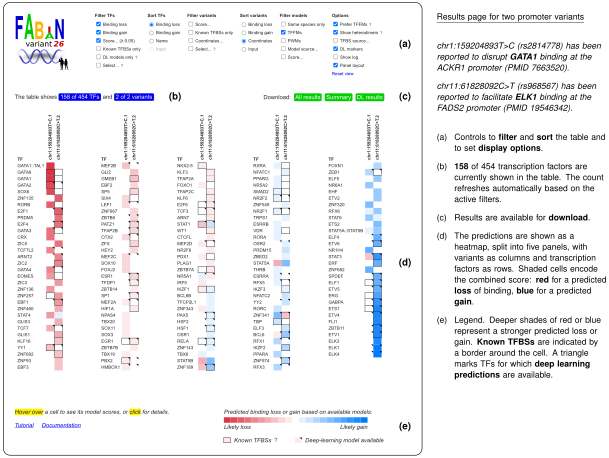
Each cell of the results table shows the combined score for a variant and transcription factor as a colour, with binding loss in red and gain in blue. Deeper shades represent a stronger loss or gain. Known TFBSs are displayed with a border around the cell.
Moving the mouse pointer over a coloured cell reveals the individual model scores. Clicking on the table cell shows the detailed results page.
Variants have the format chr1:159204893T>C.1 or AGTCCTTGGCTCTTAT>AGTCCTTGGCTCTTAC*.1.
In both cases, .1 is the line number of the variant in the input.
* indicates that some bases of a long sequence are not displayed.
Clicking on a variant opens the corresponding location in the UCSC Genome Browser.
Clicking on a transcription factor opens Ensembl.
The results table can be filtered and sorted in the browser using the checkboxes and radio buttons in the header of the page. Filtering and sorting only consider the currently visible TFs and variants. Filters combine per variant, so a transcription factor is kept only where the selected conditions are met at the same variant, for example a notable effect at a known binding site.
- Filter TFs
- Binding loss: Display TFs with at least one predicted binding loss in the visible variants (combined score < 0).
- Binding gain: Display TFs with at least one predicted binding gain in the visible variants (combined score > 0).
- Score...: Show only TFs whose combined |score| reaches the entered minimum (between 0 and 1) as a binding loss or gain in at least one variant. For the 'All TFs' search it is enabled by default at 0.05, hiding TFs with no notable effect. Clear it to show all TFs.
- Known TFBSs only: Only display TFs with at least one known TFBS in the visible variants.
- DL models only: Only display TFs for which a BPNet deep learning model is available. Available when genomic coordinates were provided.
- Select...: When activating the checkbox, all TF names are immediately highlighted grey (selected state). Click on a TF name to change the selection. Then use the Enter key to keep all selected TFs or use the Backspace key to hide all selected TFs.
- Sort TFs
- Binding loss: TFs are sorted by their combined scores over all visible variants, strongest losses first.
- Binding gain: TFs are sorted by their combined scores over all visible variants, strongest gains first.
- Name: TFs are shown in alphabetical order (default).
- Input: TFs are shown in the order of the entered name list (available when names were pasted on the search page).
- Filter variants
- Score...: Show only variants whose combined |score| reaches the entered minimum as a binding loss or gain for at least one visible TF.
- Known TFBSs only: Only show variants with at least one known binding site of the visible TFs.
- Coordinates...: When activating the checkbox, an input field opens where you can enter chromosome and position. The following formats are accepted: chr1 (whole chromosome), chr1:155259323 (exact position), chr1:155259000-155260000 (range)
- Select...: When activating the checkbox, all variants are immediately highlighted grey (selected state). Click on a variant to change the selection. Then use the Enter key to keep all selected variants or use the Backspace key to hide all selected variants.
- Sort variants
- Binding loss: Variants are sorted by total predicted binding loss over all visible TFs.
- Binding gain: Variants are sorted by total predicted binding gain over all visible TFs.
- Input: Variants are shown in the order in which they were listed in the input (default).
- Coordinates: Variants are sorted by chromosome and position.
- Filter models
- Same species only: Exclude models derived from another species (off by default).
- TFFMs and PWMs: Include or exclude the two model classes in the combined score. A class is disabled when it was not selected on the search input page.
- Model source...: Restrict the combined score to models from a single source database.
- Score...: Enter a minimum absolute per-model score. Models below the minimum are excluded from the combined score, and TFs left with no remaining model are removed.
- Options
- Prefer TFFMs: When checked (default), the combined score is calculated using only TFFMs when both PWMs and TFFMs exist for the same transcription factor. When unchecked, both types of models are included in the combined score. The checkbox is automatically disabled when only one type of model was selected on the search input page.
- Show heterodimers: When checked, heterodimer complexes (e.g., MAX::MYC) are displayed as separate rows in the results table. When unchecked (default), heterodimer results are merged into their component TFs. This checkbox is only available if heterodimers were included (merged or shown separately) on the input page.
- TFBS source...: When enabled, known TFBS highlighting is restricted to a single database source (e.g., only ENCODE or only ReMap). This allows focusing on binding sites confirmed by a specific source.
- DL markers: Show or hide the triangle in the top-right corner of a cell that indicates a BPNet deep learning model is available for the TF. Available when genomic coordinates were provided.
- Show log: Display or hide the computation log.
- Panel layout: By default, when only a few variants are analysed, the results are arranged in multiple side-by-side panels for better readability. The checkbox can be used to disable this feature.
- Reset view: Reset all filters back to their default state.
Results retention
Results are accessible via unique URLs and retained on the server for 14 days after the analysis is complete. After this time, they are automatically deleted.
Results can also be manually deleted before the retention period expires by clicking the 'delete' link in the computation log. Deleting results removes all information about the search parameters and uploaded variants from the server. Deleted results cannot be restored.
To extend the retention period, click the 'save' link in the computation log on the results page (visible under 'Options > Show log'). A verification email will be sent to the provided address. Once confirmed, the project is excluded from automatic deletion. Saved projects can still be deleted manually at any time using the link in the verification email.
Download format
The full download of all results has the following columns:
variant tf model_id database ref_score alt_score start_ref end_ref start_alt end_alt strand_ref strand_alt prediction score
variant: The name of the variant has the formatchromosome : position REF ALT . variant_numbertf: Name of the transcription factormodel_id: The ID in the source database, the species the model was derived from, and the transcription factor, joined asid@species@tf(e.g.MA0002.1@homo_sapiens@RUNX1)database: Source database of the modelref_score,alt_score: The highest score in the reference and variant sequencestart_ref,end_ref: Location with the highest score in the reference sequence relative to the variantstart_alt,end_alt: Location with the highest score in the variant sequence relative to the variantstrand_ref,strand_alt: Strand of the location with the highest score in the reference and variant sequenceprediction: Prediction of a gain or loss of binding, or NA if the model predicts no variant effect on binding (either no binding site found in either allele, or reference and variant bind equivalently)score: Score of prediction between −1 (likely binding loss) and +1 (likely binding gain)
The summary download mirrors the results table and reflects the filters and sorting currently applied on the results page.
Scores for a known TFBSs are marked with *.
Programmatic access
FABIAN-variant provides a RESTful JSON API for programmatic access, and it is the recommended interface for new integrations. The API supports variant submission, job-status polling, retrieval of results, and job deletion, returns structured JSON responses, and can be tested directly in the browser. The API documentation includes ready-to-run examples for Python, Perl, and cURL.
The legacy form-based interface also remains available for compatibility with scripts written against earlier versions. On Unix-based systems, cURL can be used to submit variants and retrieve results. Analysis runs asynchronously, so the results file is polled until it becomes available. A single variant can be submitted and its results fetched with:
printf "($(date +%T)) Submitting " && \
FABIANID=$( curl -sLD - -o /dev/null \
-F "mode=single" \
-F "single_variant=chr1:159204893T>C" \
-F "genome=hg38" \
-F "tfs_filter=all" \
-F "sources=JASPAR-PWM JASPAR-TFFM HOCOMOCO" \
https://fabianapp.org/variant26/analyse \
| grep -im 1 "location: " | grep -o "\([0-9]\+_[0-9]\+\)" ) && \
i=1; until curl -sfo fabian.data_${FABIANID} \
https://fabianapp.org/variant26/temp/${FABIANID}/fabian.data; \
do printf "\r($(date +%T)) Waiting for $FABIANID"; \
[ $i == 30 ] && sleep $i || sleep $((i++)); done && \
printf "\r($(date +%T)) Saved file fabian.data_${FABIANID}\n"
Some parameters are specific depending on the mode and which transcription factors you are looking for. A few examples are listed below.
- Single variant:
-F "mode=single" \ -F "single_variant=chr1:159204893T>C" \ -F "genome=hg38" \ - Single variant (sequences):
-F "mode=single_seq" \ -F "single_ref=AGTCCTTGGCTCTTATCTTGGAAGCACAGGC" \ -F "single_alt=AGTCCTTGGCTCTTACCTTGGAAGCACAGGC" \ - Multiple variants:
-F "mode=batch" \ -F "batch_variants=chr1:159204893T>C chr11:61828092C>T" \ -F "genome=hg38" \ - Multiple variants (sequences):
-F "mode=batch_seq" \ -F "batch_ref_alt=AGTCCTTGGCTCTTATCTTGGAAGCACAGGC AGTCCTTGGCTCTTACCTTGGAAGCACAGGC TCGAGGCCCTGAGCTCCCGGGGAGTTTTTAC TCGAGGCCCTGAGCTTCCGGGGAGTTTTTAC" \ - Search for individual transcription factors:
-F "tfs_filter=names" \ -F "tfs_custom_names=SP1 SP2 SP3 SP4" \ - Include deep learning predictions (BPNet; requires genomic coordinates):
Deep learning results are written separately to-F "dl_scoring=1" \dl_results.tsvin the same job directory and typically become available after the main analysis. Poll for them the same way:until curl -sfo dl_results_${FABIANID}.tsv \ https://fabianapp.org/variant26/temp/${FABIANID}/dl_results.tsv; do sleep 2; done - Restrict to same-species models only:
-F "same_species=1" \ - Get notified via email when results are available:
-F "email=your@email.edu" \
If the request is correct, cURL polls the server until results are available, which are then saved under a project-specific name (e.g., fabian.data_1650751034_19489).
Please note that the polling loop can wait indefinitely in case of an error.
The status can always be checked at the project-specific URL (e.g., https://fabianapp.org/variant26/1650751034_19489).
VCF submissions follow the same pattern, except the input is uploaded as a file.
Submit with -F "mode=vcf" and -F "filename=@TinyExample38.vcf" in place of the single-variant fields.
VCF result tables can be large, so they are also written as a compressed archive (fabian.data.zip), which is smaller to download.
Poll for it the same way:
until curl -sfo fabian.data_${FABIANID}.zip \
https://fabianapp.org/variant26/temp/${FABIANID}/fabian.data.zip; do sleep 2; done
Please do not run more than three automated requests at the same time! If you require more processing slots, please send a short email with details of your request.
Standalone version
For users who require local offline execution or need to process large amounts of data, a standalone version of FABIAN-variant can be run on local infrastructure. The standalone tool is a single C++ executable with prediction models from openly-licensed sources embedded, requiring no additional dependencies.
See the standalone version documentation for technical details, command-line options, and download links.
History
FABIAN-variant is an update of the ePOSSUM software.
The initial version of FABIAN-variant was released on 20 December 2021.
FABIAN-variant 2026 is the second major version, featuring updated model databases, mouse genome support, and deep learning models. See the what's new and changelog pages for details.
Citation
If you use FABIAN-variant in your work, please cite:
Steinhaus R, Robinson PN, Seelow D. FABIAN-variant 2026: improved prediction of the effects of DNA variants on transcription factor binding. Nucleic Acids Research. 2026;gkag449. https://doi.org/10.1093/nar/gkag449
The original version is described in:
Steinhaus R, Robinson PN, Seelow D. FABIAN-variant: predicting the effects of DNA variants on transcription factor binding. Nucleic Acids Research. 2022;50:W322–9. https://doi.org/10.1093/nar/gkac393
Acknowledgements
FABIAN-variant relies on data from multiple public databases. Each source is governed by its own license terms.
- Transcription factor binding models
Source License Reference JASPAR 2024 CC BY 4.0 Rauluseviciute et al., Nucleic Acids Research, 2024 JASPAR 2026 CC BY 4.0 Ovek Baydar et al., Nucleic Acids Research, 2026 HOCOMOCO v14 WTFPL (treatable as CC BY) Vorontsov et al., Nucleic Acids Research, 2024 CIS-BP 3.00 Not stated / Different sources Weirauch et al., Cell, 2014 SwissRegulon CC BY 4.0 Pachkov et al., Nucleic Acids Research, 2013 Factorbook Not stated / CC BY-NC 4.0 Pratt et al., Nucleic Acids Research, 2022 SELEX collection Different sources / MIT Jolma et al., Cell, 2013
Jolma et al., Nature, 2015
Nitta et al., eLife, 2015
Yin et al., Science, 2017
Xie et al., Nature, 2025UniPROBE “available under the terms of an academic research use license” Hume et al., Nucleic Acids Research, 2015 HOMER GPLv3 Heinz et al., Molecular Cell, 2010 hPDI “free to academic and non-profit organizations” Xie et al., Bioinformatics, 2010 - Known transcription factor binding sites
Source License Reference ENCODE “External data users may freely download, analyze and publish results based on any ENCODE data without restrictions” ENCODE Project Consortium, Nature, 2012 ReMap 2022 CC BY-NC 4.0 Hammal et al., Nucleic Acids Research, 2022 ChIP-Atlas CC BY 4.0 Zou et al., Nucleic Acids Research, 2024 UniBind CC BY 4.0 Puig et al., BMC Genomics, 2021 Ensembl Regulation “Ensembl imposes no restrictions on access to, or use of, the data provided” Yates et al., Nucleic Acids Research, 2026 - Population and strain variants
Source License Reference gnomAD CC0 1.0 (primary exome/genome data) Guez et al., medRxiv (preprint), 2026 Mouse Genomes Project (MGP) “released in accordance with the Fort Lauderdale agreement and Toronto agreements” Keane et al., Nature, 2011 - Species silhouettes (PhyloPic)
Species License Credit Homo sapiens Public Domain Mark 1.0 NASA, uploaded by Yan Wong Mus musculus CC0 1.0 Cagri CEVRIM Bufo bufo CC0 1.0 Beth Reinke Drosophila melanogaster CC0 1.0 Andy Wilson Caenorhabditis elegans CC0 1.0 Bob Goldstein, vectorization by Jake Warner Arabidopsis thaliana CC0 1.0 Arcadia Science Nannochloropsis sp. CC0 1.0 Arcadia Science
Team
FABIAN-variant 2026 has been developed at the BIH (Berlin Institute of Health @ Charité – Universitätsmedizin Berlin) by
- Robin Steinhaus
- Peter N. Robinson
- Dominik Seelow
Contact
If you have suggestions about this software, please email robin.steinhaus (at) bih-charite.de. If you discover a bug, please submit a ticket via email using this link.